The transcript did not predict any of it
· 8 min read
Arshi Niyaz is Co-Founder and Chief Science Officer at Biotech Wallah. She was there before there was a company to be an officer of, which is why the first title matters more than the second.
We met at college. I was in second year, she was in first, same department. We ended up on projects together, then internships, then the thing that became Biotech Wallah. That sequence matters more than the title does. By the time there was a company to join, we had already spent years learning how the other person behaves when an experiment has failed for the fourth week running.
The mark sheet was a lagging indicator, twice
I should be precise here, because the obvious reading of my title is wrong.
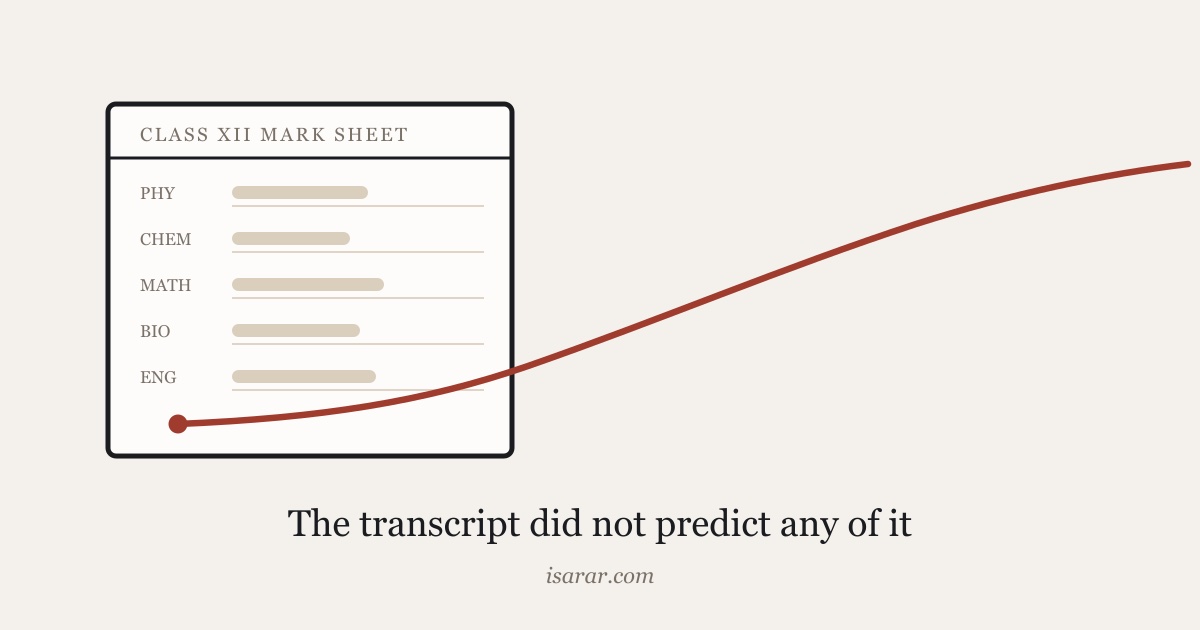
Start at school. Her marks at a rural CBSE school were average. A Class XII mark sheet could describe that moment, but it could not predict what followed. Her father supported her education throughout. His support belongs in this account because the barriers around her were never a simple story of her family standing in her way.
Then college. Arshi graduated with honours. She is on the AKTU honours list, and she earned it the slow way, semester after semester, without a single term where she coasted. So the final transcript does reflect her. My claim is narrower and I think more useful: it never once predicted her. It recorded what was already happening, and it recorded it late.
That is the same instrument failing twice in a row. The school sheet did not predict the honours degree. The early college marks did not predict that she would later become a Co-Founder and Chief Science Officer. Two independent measurements, taken years apart, both described a position and told you nothing about a direction.
So the useful distinction is not grades against no grades. It is the snapshot against the slope.
A snapshot of attainment mostly measures where somebody currently is, and where somebody currently is depends heavily on where they started. For a student who began further back, an early mark sheet is largely a measurement of the starting gap rather than of the person. The slope measures what they do with time, which is the thing you actually wanted to know and the only thing that transfers.
For girls who look at an ordinary school record and read it as a ceiling, Arshi's trajectory is a concrete counterexample. Average school marks were followed by an AKTU honours degree through consistent work. The lesson is not that marks are meaningless. It is that a current mark is not a final limit.
That distinction matters even more once the work stops being coursework. A transcript measures performance on bounded tasks: the scope is defined, the deadline is published, the method has been taught, and somebody already knows the answer. Research has none of those properties. The scope is unclear, no deadline is enforced by anyone, the method usually has to be invented for your particular mess, and nobody knows the answer, including your supervisor. Very little of what makes a person good at the second thing is measured by the first, and what does carry over is the slope rather than the position.
There is a sharper version of this. Students who have been rewarded for getting things right on the first attempt often struggle most in a lab, because the structure they grew up inside taught them that repeated failure indicates personal inadequacy. In research, repeated failure indicates Tuesday. The people who last are the ones for whom an uninformative result is data rather than a verdict.
Where the consistency comes from
I used to describe what Arshi has as consistency and leave it there, as though it were a personality trait she happened to be issued. That is not an explanation, so here is the one I think is true. It is also, I think, where the honours degree actually came from.
She is from a village. She is a Muslim woman. In India those facts can add social and geographic friction to a girl's education that has nothing to do with ability. Her father's support was consistent, so this is not a story of family opposition. She was the eldest, and the first girl in her family to study in the city. Her younger sister and brother then had a path she had helped make possible.
None of that is here to decorate the story. It is part of the causal account.
Someone who has had to work around that friction does not treat a place in a classroom as ambient. That shows up in the work in a way I can point at. It is the reason participant two hundred in our screening trial gets the same instructions, in the same order, with the same refusal to accept a bad capture, as participant three. It is the reason the audiometry still gets taken at the end of a long afternoon, when the queue is out of the door and nobody would notice if it were quietly skipped.
That last one matters more than it sounds. The entire validity of a screening study rests on treating the two hundredth person exactly like the third. Standardisation is not a bureaucratic virtue, it is the only reason the numbers mean anything, and standardisation is entirely a question of whether a person can be bothered on a bad day. I wrote recently that a covariate you failed to measure has no later substitute. The people who keep measuring it tend to be the people for whom the opportunity was never free.
Remote was not a convenience
Relocating was not available to her. So she did it remotely, all of it, including a summer traineeship at Stanford carried out from here.
I want to sit on that for a moment, because remote work gets discussed in one part of the world as a lifestyle preference and functions in another as the only door there is. For a great many capable people in India, and disproportionately for women, the question was never whether they would do well somewhere else. It is whether they can get there at all. When the answer is no, remote is not a compromise on the opportunity set. It is the entire opportunity set.
And it is harder, not easier. Remote work hands you the task and withholds the room. You get the deliverable and none of the corridor: no supervisor noticing you at the coffee machine, no accidental collaboration, no being in the building when somebody needs a pair of hands and remembers your name six months later. Almost every second order benefit of a research position is spatial, and remote strips them all out and leaves you with the work itself, judged on its own, with nobody advocating for you.
Doing a Stanford traineeship under those conditions is not the same achievement as doing one after moving to California. It is a larger one, and it is routinely read as a smaller one.
Consistency, concretely
Research is mostly failed runs. The rate limiting factor is almost never insight, because ideas are cheap and most of us have more of them than we can test. The limit is willingness to build the twentieth version of a pipeline after nineteen produced nothing worth writing down. Anyone can be excellent for a fortnight. The rare thing is arriving on day four hundred with the attention you had on day four.
I have watched that from the year below me in a college corridor through to a running clinical trial, and I have never once seen it correlate with a mark sheet.
She does not shrink the problem
The other thing I would say, and it is harder to evidence so read it as my opinion rather than a claim, is that she refuses to reduce a question to fit the resources available.
The characteristic failure of a resource constrained lab is quiet ambition collapse. You cannot afford the good instrument, so the question narrows to whatever the cheap instrument can answer, and two years later you are working on something nobody needed. Arshi consistently argues the other way: hold the question, find another route to it. Several design decisions in our screening work exist because she would not accept a smaller version of the problem when the obvious path was blocked.
One more thing
Everything above is my account, from my side of it. Her own account of how she got here is hers to give, and if she ever writes it down it will be better than this, because she was there for the parts I only heard about afterwards.
She is at linkedin.com/in/arshi-niyaz.
Related: operations is where the science survives, on why trial logistics is a research decision, and the wrong person to tell you about my brother, on seven years of compounding.