Operations is where the science survives
· 7 min read
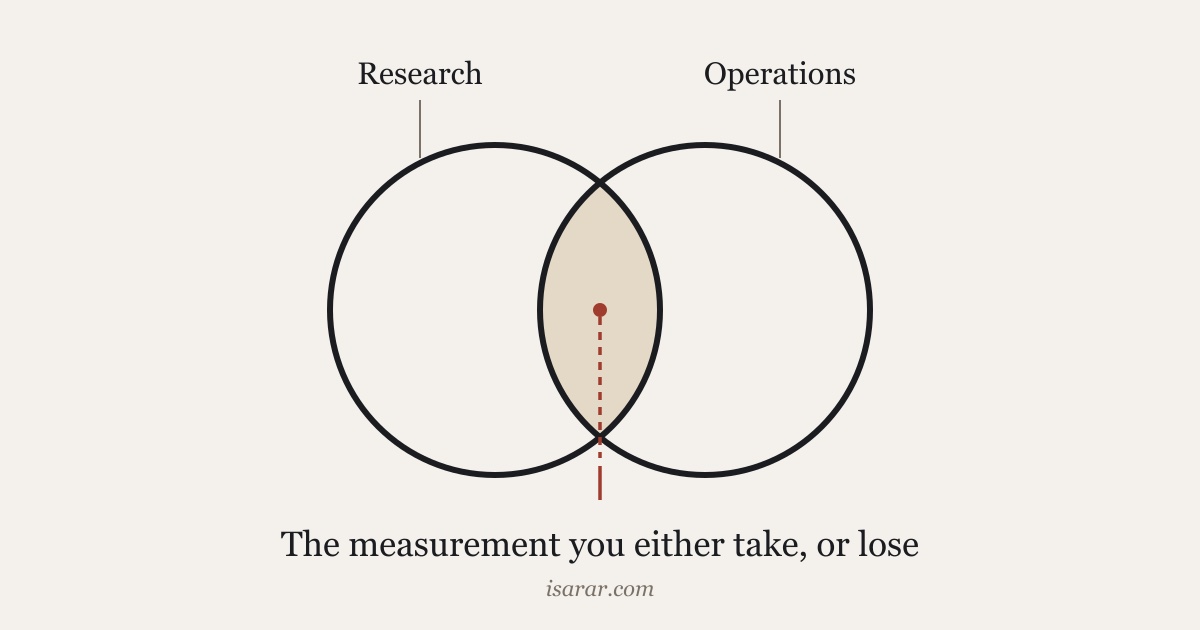
Jamyang Ugyen Tshomo has joined Biotech Wallah as Chief Operating Officer. She owns research and development alongside operations, clinical coordination, trial logistics and hiring. That combination is deliberate rather than a matter of headcount, so it is worth explaining why we put them together.
Trial logistics is research design wearing a different hat
I have written before that in our screening trial the model was never the hard part. What decided whether the tool got used was everything around it: a consultation window of under three minutes, a clinician with a queue outside the door, consent that had to work for people who could not read it.
The part that is easy to miss is that those are not administrative problems sitting downstream of the science. They are the science.
Every session in our trial captures paired audiometry alongside the voice recording. That single decision is the reason I can say anything defensible about hearing loss as a confound, and hearing loss matters enormously here. It lowers Montreal Cognitive Assessment scores by around 1.66 points independently of cognition (PMID 32458435), and removing the auditory subtests collapses sensitivity for mild cognitive impairment from roughly 90 percent to between 43 and 56 percent (PMID 31018015). It also changes voice production, because auditory feedback is part of the control loop, so an elderly hearing impaired speaker is not simply a harder instance of the same distribution.
If the person running recruitment does not understand why that measurement matters, it does not get collected. And there is no later substitute for a covariate you failed to measure. You cannot model your way back to it, you cannot impute it honestly, and no amount of care in analysis recovers information that was never captured. The cheapest moment to measure a confound is while you are collecting, and after that the moment is gone.
So who runs logistics is not separable from whether the study is any good. A coordinator who is only a coordinator will optimise for throughput, because throughput is the visible metric and nobody gets thanked for a slow clinic. Someone who also does the research will protect the measurements that make the results mean something, including the ones that lengthen the queue. That tension has to live inside one head, or it becomes an argument between two departments and the queue wins.
What separating them actually costs
Three failures, in rough order of how badly they hurt and inverse order of how visible they are.
Throughput pressure produces missingness that flatters you. This is the one I find most alarming, because the incentive runs the wrong way and the damage looks like success. When a clinic is under time pressure, the sessions that get abandoned are the slow ones. The slow ones are slow for reasons: the participant is frailer, more impaired, harder to instruct, cannot hear the prompt. So the people who drop out are systematically the people nearest the decision boundary, and removing them makes the remaining problem easier. Your numbers improve. Nothing about the tool improved. A dropout log that records only a count, rather than who dropped and at which task, will never show you this, and most studies keep exactly that kind of log.
Recruitment fixes the confound structure before any feature exists. Who walks through the door decides what correlates with your outcome. If participants arrive through a route that is enriched for one comorbidity, that comorbidity becomes associated with the label before a single number is computed, and no covariate added in analysis repairs it, because it is a sampling problem rather than a measurement one. That distinction is easy to state and easy to lose, and the person who can see it coming is the person designing the recruitment path, not the person who receives the dataset three months later.
Protocol drift is silent and cumulative. Over months, a coordinator solving practical problems makes analysis decisions without knowing they are analysis decisions. This participant could not manage the drawing task, so skip it. That room was noisy, so use the other one. Each choice is locally sensible and each one changes the data generating process. Unless the deviation is recorded as a deviation, the dataset quietly contains two different studies stapled together, and you will find out when a subgroup behaves inexplicably and you cannot reconstruct why.
A fourth, smaller one worth naming: the decision to reject a bad capture has to be made at capture. Our hardware abstains on a channel when contact impedance is poor rather than emitting a number the model will treat as real, and the same logic applies to a human operator. If nobody declines the unusable recording in the room, it enters the dataset with the same status as a good one.
None of these are caught by better analysis. They are all decided in the corridor, on the day, by whoever is standing there. That is why research and operations sit with the same person here rather than in two boxes on an org chart.
What she brings to it
Jamyang read Biotechnology at NIIT University in Neemrana, on a four year project based programme, which matters more than it sounds: she arrives having built things and reported on them rather than only having attended. Before that she was at The Royal Academy in Paro, a residential school for Grades 7 to 12 under the Druk Gyalpo's Institute in Bhutan.
I want to be careful here, because explaining a colleague by where she is from is both lazy and unfair. So let me name the one place it genuinely changes the work.
We build clinical tools for South Asia, and nearly every assumption we hold is calibrated to one health system and one language ecology. Bhutan is structured differently from India in both. Someone who grew up inside a different arrangement notices the defaults we cannot see, because to her they are not defaults, they are choices. That is a narrow and specific research asset, and it is worth more than any general claim about perspective.
It also bears directly on something I argued earlier this month: that evaluation for Indian language health tools is largely borrowed, tested in registers that do not occur in a real clinic. Having someone on the team whose linguistic intuitions were not formed in the Hindi belt is a check on that rather than a garnish.
What changes now
Concretely: recruitment protocols, consent instruments, site coordination and the hiring of the next few people move to her, and she has the authority to slow a study down in order to protect a measurement. I keep model and method work. Of everything being handed over, trial logistics is the one I care most about getting right, because that is where a study quietly stops being valid without anyone noticing.
Welcome, Jamyang. She is at linkedin.com/in/jamyangut.
Related: the three minute constraint, on what a real outpatient window does to a design, and a screen that is 95 percent accurate is wrong about half the time.