How I cold-emailed my way into eleven research labs
· 6 min read
I did my undergraduate degree in biotechnology at a state affiliated college in Lucknow. It had no research pipeline, no lab I could join, and no faculty connections into the places I wanted to work. Nobody from my course had gone to Harvard or Stanford. There was no path, and pretending otherwise would have wasted a year.
Over the next three years I worked in eleven labs. Harvard, Stanford, NASA GeneLab, the University of Tokyo, ISRO's Physical Research Laboratory, IISc Bangalore, three IITs and others. I did not go through a single application portal for any of them.
I want to be precise about what happened, because "just cold email people" is useless advice and it is not what worked.
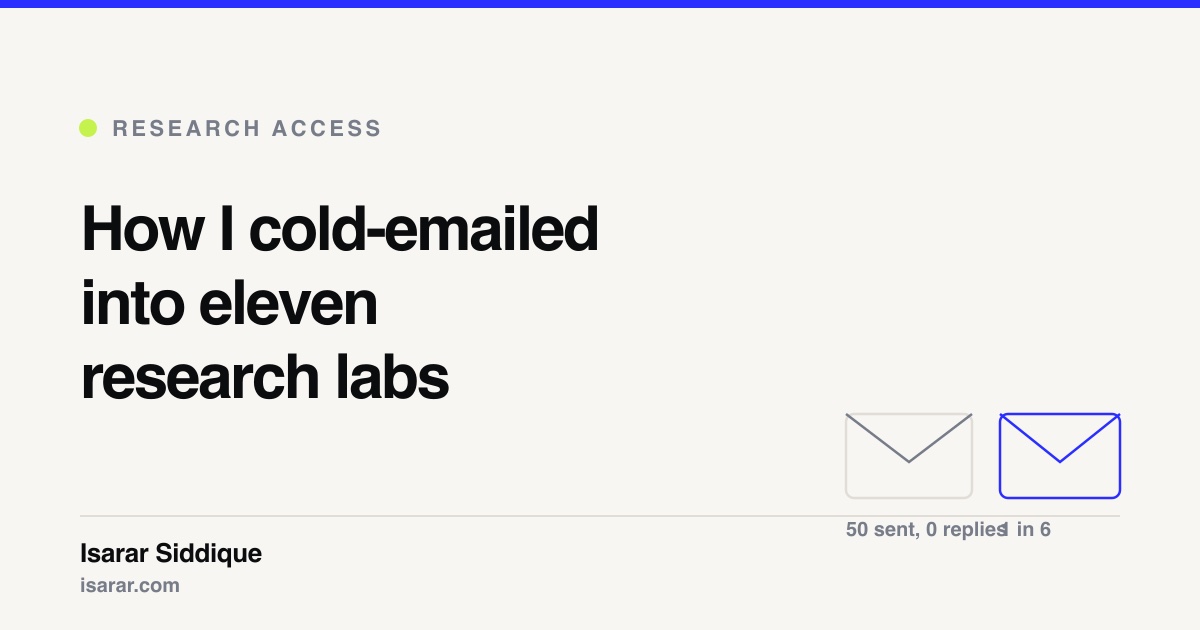
The first fifty emails failed completely
My early emails looked like everyone's. I introduced myself, listed my CGPA, said I was passionate about the professor's field, attached a CV, and asked whether there were any internship opportunities in their lab.
Reply rate: zero. Not low. Zero.
It took me an embarrassingly long time to work out why. That email asks the recipient to do work. It asks them to evaluate me, imagine a project, find funding and assign supervision, all for a stranger with no track record from an institution they have never heard of. The rational response is to archive it. I would have archived it.
An ask costs the recipient something. An offer costs them nothing. That distinction is the entire trick.
What I changed
I stopped asking for internships. For each professor I did this instead:
- Read their three most recent papers properly. Not the abstracts, the methods.
- Find one specific thing. A gap they flagged in their own discussion section, a dataset they published but never fully analysed, a method they applied to one cohort and not another.
- Write four or five sentences proposing exactly what I would do about it in the first two weeks. Unpaid. Remote. No supervision required.
That is it. No CV in the first email. No mention of my college. No paragraph about my passion for the field.
Reply rate went to roughly one in six.
Why it works
A specific proposal proves three things at once that a CV cannot. It proves you actually read the work, because you cannot fake a real gap in someone's methods section. It proves you can scope a piece of work, which is most of what research competence is. And it removes their risk entirely, because if I disappeared after a week they had lost nothing.
The unpaid part mattered more than I would like it to. I am not going to pretend that is a fair system. It meant I could only do this because I had somewhere to live and no dependents. But the mechanism underneath it, make the first move costless for the other person, does not require working for free. It requires arriving with something finished.
The part nobody tells you
Eleven labs sounds impressive on a list. In reality several were one month long. Some produced nothing publishable. One I discontinued. A few professors stopped replying after the initial project and I never found out why.
The hit rate on meaningful collaborations was far lower than the reply rate. Maybe one in four turned into work I would defend today. If you try this, expect that, and do not measure yourself on the length of the list.
Using it for something harder
The reason I still think about this is not academic access. It is that the same move worked on a much harder problem.
When I started Zero Dementia, smartphone based screening for early cognitive impairment, I needed hospitals. Hospitals are far more conservative than professors. A tertiary institute has no reason to let a 22 year old anywhere near their patients.
So I did not ask for patients. I built the screening infrastructure first. The recruitment workflow, the consent handling, the data collection pipeline. Then I went to a tertiary government hospital and two medical colleges with a working system and asked them to tell me what was wrong with it.
That conversation is completely different from asking for access. It is a clinician critiquing a tool, which is something they actively want to do. Those partnerships became the clinical trials running now.
If you are going to try this
Three things I would tell my younger self.
Volume without specificity is spam. Fifty generic emails got me nothing. Ten researched ones got replies. The research is the work. The email is just delivery.
Read the discussion section. That is where researchers write down what they could not finish. It is a public list of things somebody wants done and does not have time for.
Deliver the two weeks you promised even if they never reply. Twice I did the analysis anyway and sent it unprompted. Both times that second email is what got the response.
None of this substitutes for being good at the work. It is a way to get a first look from people who would otherwise never see you, which, if you are starting from a place with no pipeline, is the only problem that matters at the beginning.
If you are doing something similar and it is not working, send me the draft. isararsiddique@gmail.com. I will tell you what I would change.